
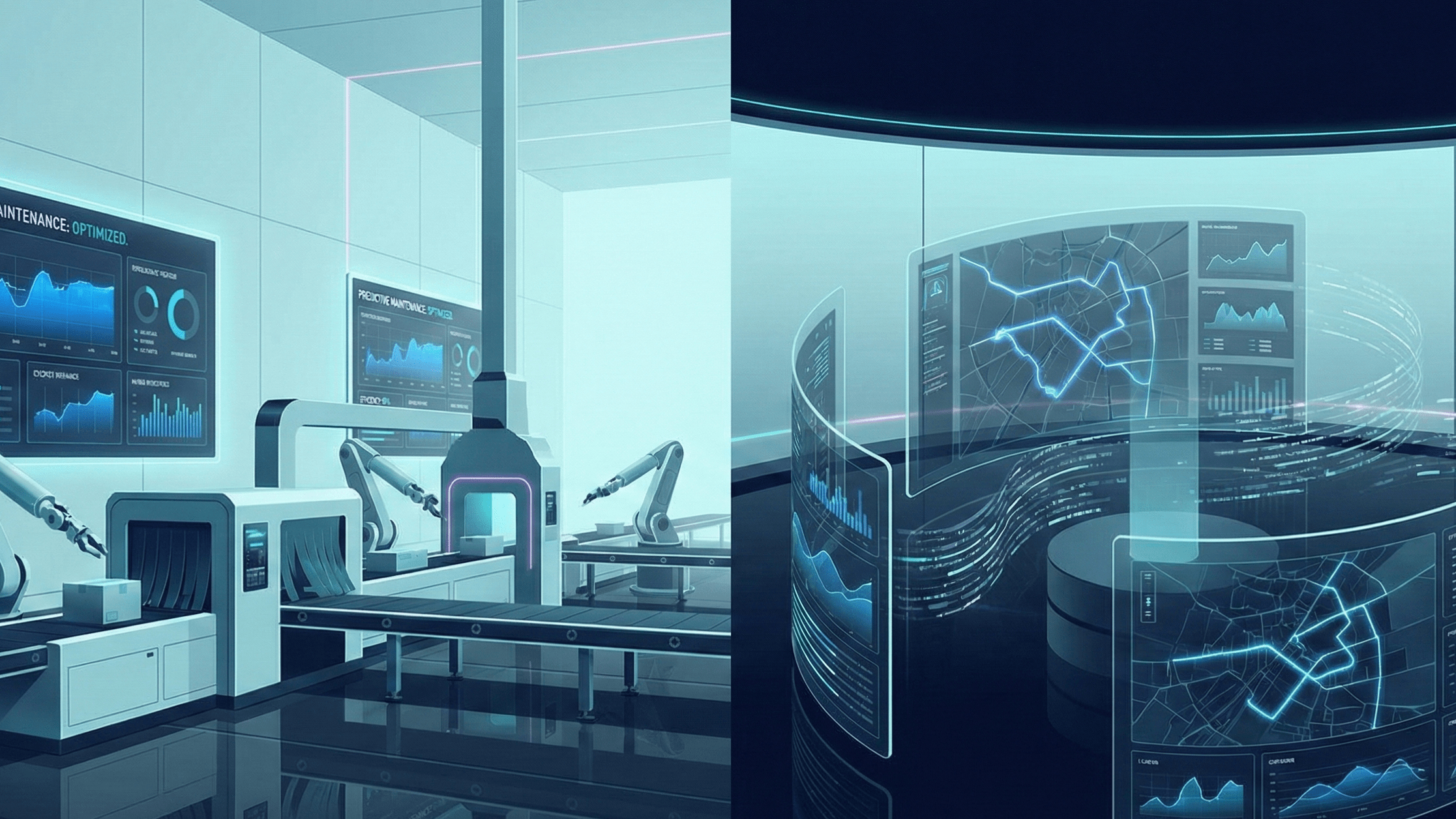
There's an unquestionable truth: AI saves money when it avoids mistakes
If we look at the public conversation, it seems that artificial intelligence is a tool for “doing things faster”: drafting, programming, creating images, automating simple tasks...
And of course, that helps. But it's not what's really moving the world's needles.
The part that is changing entire companies - and that hardly anyone presumes as it should - is this:
AI avoids expensive errors. And when you avoid mistakes, you save money. A lot of money.
And it's funny, because those cases never show up in trends.
Nobody goes viral with a video that says: “We reduced our plant's downtime by 23%.”
But it is precisely those numbers that sustain the planet.
As a Peaking team, we see this in sales every day: when a prospect goes unattended, when a hot conversation is lost, when no one answers on the weekend... all of that also costs money. The invisible also hurts.
That's why we love these cases: they reflect exactly the kind of impact that AI is making behind the scenes.
1. Machines now warn before they fail (and that saves entire budgets)
According to Siemens, AI-based predictive maintenance reduces downtime to 50% in industrial plants.
It's as if machines stopped “dying without warning”.
On a financial level, that's outrageous.
2. Logistics without money leaks: AI decides routes better than us
DHL, FedEx and UPS all agree on one thing: predictive optimization is saving millions.
Fewer useless kilometers.
Less dead inventory.
Less fuel wasted.
It doesn't look glamorous... but it's pure gold.
3. Retail that no longer buys (or pulls too much)
Walmart uses AI to anticipate hyperlocal demand.
Result: less waste, more turnover, less inventory frozen in warehouses.
Efficiency ceased to be intuition and became mathematical modeling.
4. Energy also learned not to lose money
The International Energy Agency documented how AI reduces losses, predicts failures and stabilizes load.
Again: fewer errors, less expense.
The savings are in what doesn't happen.
5. Entire governments are saving time (and yes, public money)
Estonia automated document analysis, bureaucratic burden prediction and administrative processes.
Fewer steps, fewer hours, less costs.
Efficiency ceased to be an aspiration and became standard.
And what does all this have to do with sales? More than it seems.
After seeing these cases - machines that prevent faults, electrical networks that anticipate problems and retailers that no longer buy too much - we understood something that we sometimes forget in sales:
Businesses don't lose money due to lack of ideas
they lose it because of the silences.
As far as no one saw.
So no one answered.
In logistics, a mistake costs fuel.
In manufacturing, it costs machine hours.
In terms of energy, it costs blackouts.
In sales... it costs customers.
And here's where conversational AI becomes just as transformative as operational AI:
not because I speak beautifully, but because It does not leave gaps.
While Siemens AI prevents a turbine from failing,
A business's AI prevents something just as expensive:
that an interested customer cools down,
that someone asks for a price and no one answers,
that a sale ready to close is lost because of a “see you tomorrow”.
And that's where Peaking has changed the game for many companies:
not only does it serve, it converts.
It doesn't just respond, it charges.
It doesn't just talk, it generates real income.
What operational AI does for machines,
Peaking does it for sales:
avoid the invisible mistakes that cost the most money.
The silences.
The forgetfulness.
Missed opportunities.
Maybe that's why 2025 feels so different:
because AI stopped being a tool “to help”
and it became a complete system that keeps a business alive,
from the factory to the WhatsApp chat.
.png)
.jpg)
.jpg)
.jpg)