.jpg)
San Francisco always had this particular vibe: a charming mess, creativity on the street corners, and a permanent sense of being a little ahead of the rest of the world.
But in 2025, the real story isn't in its cafés full of founders or in the startups that are born in tiny apartments.
It's in what you can't see.
San Francisco became the first city to operate as a living urban laboratory.
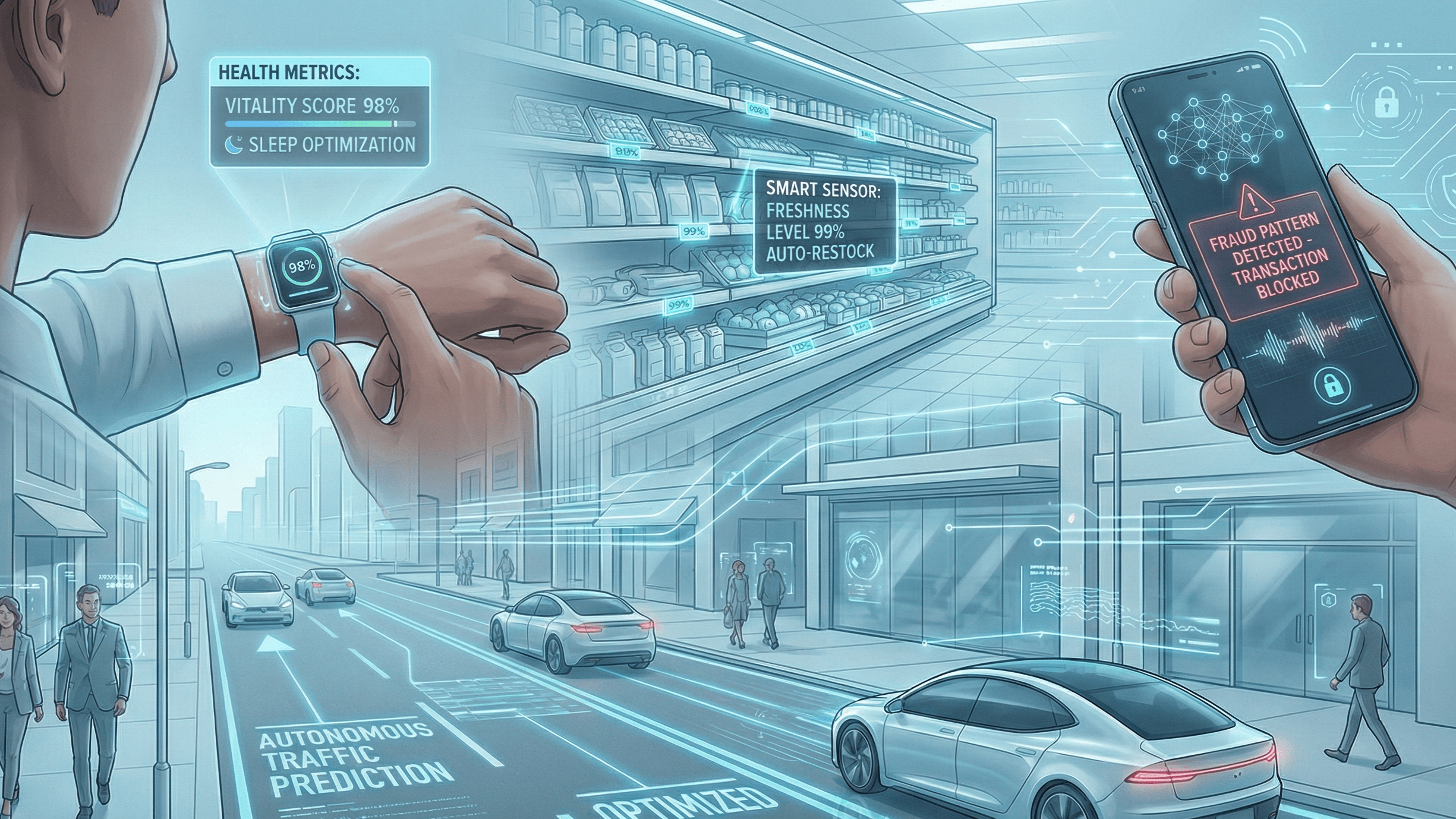
A place where AI is no longer discourse, but infrastructure: it adjusts, predicts, corrects and sustains the lives of nearly a million people without anyone noticing it.
For us at Peaking—with our base of operations here too—this city isn't just home:
is a daily reminder of what it means for technology to work in the background, sustaining a real operation without interrupting it.
Here we understood something essential:
the AI that changes things is not the one that is on display;
is the one that maintains order where there could be chaos.
1. San Francisco: Where Traffic Learns to Flow Alone
In several districts of the city, models trained with data from autonomous fleets, urban sensors and historical patterns adjust the flow in real time.
Researchers from Stanford, Berkeley and the San Francisco County Transportation Authority reported in 2025 that intelligent coordination reduced to 18% crossing times in areas of high congestion.
The magic isn't in a new bridge or in another lane:
It is in how the city interprets thousands of microsignals — climate, density, neighborhood rhythms — to prevent chaos from forming.
The city doesn't “move”:
is anticipated.
2. Energy: When AI protects those who can't afford a blackout
What's happening in San Francisco isn't unique to California.
Tokyo, Madrid, Quebec and Texas face the same challenge: aging networks, unpredictable weather, growing consumption.
The answer is no longer to build more cables, but more interpretation.
The U.S. Department of Energy reported that AI systems in power grids reduce by 30% high-risk events when detecting anomalies invisible to the human eye:
microscopic oscillations, irregular tensions, minimal changes in the “breathing” of equipment.
It's the difference between a blackout and a silent setting.
3. Urban security: intervening before, not later
In Barcelona, Seoul and Chicago, early detection models identify anomalies in public areas:
irregular flow, atypical crowds, signs that usually precede incidents.
MIT Urban Computing reported reductions between 15% and 20% in incidents in areas with early warning systems.
AI is no substitute for the police:
gives them a vision that the eyes cannot reach.
San Francisco as Peaking's operating mirror
When we work from San Francisco, we see the city as a map of signs:
how a street changes its pace when the Pacific fog comes,
How do traffic lights react when there's a Giants game,
how traffic is compacted when a single bus stops longer than usual.
And it's impossible not to see the parallel with the operations of a business.
An ignored conversation can create both chaos and a poorly calibrated traffic light.
An appointment not scheduled on time can stop the operation like a saturated intersection.
A customer that is left waiting is as critical as a bus that breaks the frequency on a line.
San Francisco taught us that Real intelligence is anticipation.
And that's the logic we apply in Peaking:
to make things work before problems occur.
4. Mobility, water and waste: the part of the city that nobody looks at
Helsinki adjusts water pressure in real time to reduce leaks.
Amsterdam detects anomalies in water networks before generating outages.
Copenhagen recalculates garbage routes according to actual capacity.
Seoul optimizes bus frequencies based on dynamic user behavior.
These are small operations that, together, make the city work with less friction.
5. What connects this to the daily operation of a business?
Much more than it seems.
Cities—including San Francisco—work better because AI:
- interprets weak signals,
- avoid mistakes before they grow up,
- makes operational decisions without asking for permission,
- and it supports complex systems in real time.
That's the same principle we apply when designing conversational systems:
A trade doesn't go down because of a big mistake.
It falls because of:
- a lost message,
- an undetected intention,
- an appointment that is never scheduled,
- a charge that no one remembers,
- an opportunity that is being diluted.
Peaking applies this same philosophy of intelligent infrastructure—not the same system, but the same operating principle—so that conversations turn into concrete actions: tasks, appointments, charges, updates.
What AI does for the city,
Peaking does this because of the conversations that sustain a business.
Conclusion
The AI that matters doesn't live in science fiction.
Live in cities like San Francisco, which already work better thanks to intelligent systems that anticipate in silence.
And for us—who built Peaking right here—it's impossible not to see it clearly:
the future doesn't come with noise; it comes with precision.
Verifiable sources
- San Francisco County Transportation Authority — Smart Transit Pilot Data (2024—2025)
- U.S. Department of Energy — Smart Grid Modernization Reports
- MIT Urban Computing Lab — Urban Anomaly Detection Studies (2024—2025)
- Transport for London — Intelligent Traffic Coordination Report (2024—2025)
- Singapore Land Transport Authority — Smart Mobility Results (2024)
- European Smart Cities Index (2025)
.png)
.jpg)